
Fort Myers Busted Booking Path
Fort Myers is the seat of Lee County. Among its incorporated cities, it ranks second in size. A Census estimate dated July 1, 2025 put the population at 101,581. The Fort Myers Police Department patrols the city. Here's the catch, though. FMPD doesn't run the jail. Once an adult arrested in Fort Myers enters county custody, the sheriff's office takes over at the Downtown Jail. LCSO says that facility handles intake and booking for every arrest in the county.
That split decides who keeps what. FMPD holds its officers' reports and the city case file. LCSO generates the booking number, the custody entry, the jail placement, the charge and bond display, and the booking photo when one exists. Don't confuse the two numbers. An FMPD incident number is not a booking number. A later result may also list the Core Facility or Community Program Unit as the assigned unit. That doesn't change where intake happened.
Check the arresting-agency field closely. A Fort Myers street address alone proves nothing about who made the arrest. LCSO, another local department, or a state agency could have acted. Match the full name, date of birth, booking date, booking number, and arresting agency before calling two entries the same event.
Fort Myers Busted Mugshot Sources
Start with the official sources. The city and county split the paperwork. FMPD's own arrest-search link hands visitors off to LCSO. The sheriff's search shows people currently held plus released bookings. FMPD records supply the underlying city report. News outlets and third-party pages offer only partial or copied views. They can point you toward a lead, nothing more. They won't settle a final charge, a custody status, or a court outcome.
| Channel | Photo? | Status | Best use |
|---|---|---|---|
| LCSO Arrest Search | When available | Official | Booking number, intake, custody, release, agency, charge and bond fields |
| FMPD Public Records Center | By lawful request when releasable | Official | FMPD report and adult arrest information tied to the city case |
| Lee Clerk Matrix | Not the booking-photo source | Official | Filed charge, docket events, orders and disposition |
| FOX 4 Lee County, WINK, NBC2, News-Press | Sometimes | Editorial | Selected Fort Myers incidents, not a complete arrest log |
| RecentlyBooked Lee County and Busted Newspaper Lee County | Often | Unofficial | Possible spelling or date lead that must be checked against LCSO |
Several third-party archives also exist: Mugshots.com, Arrests.org, Mugshots.zone, and MugshotsLeeCounty.com. Treat all of them with caution. Entries can sit stale, incomplete, or simply wrong. None will track an official change the moment it happens. Don't let any of these fill a gap where an official photo is missing. The same goes for a news image. Verify the booking with LCSO, then check the outcome with the Clerk.
Note: No complete current FMPD daily-arrest blotter exists, so selective police or news releases can't replace the county search.
Find Fort Myers Busted Bookings
Searching by city works best when you follow record custody, not just a place name. The county interface covers current and released bookings. Its recent-booking control is a rolling view of the current and prior day, not a promised exact window. Want a wider sweep? A custom booking-date range spans up to seven days at once. LCSO posts no fixed refresh interval. So a short delay or a blank image field never proves a booking doesn't exist.
- Open the official LCSO Arrest Search. Enter the full name, date of birth, or booking number. Use a booking number when available to avoid common-name matches.
- Check the arresting-agency field for Fort Myers Police Department. Do not infer the agency from a home address, news dateline, or arrest location.
- Read the custody or release status and booking timestamp. Expand the record for charges, bond, case, court, and hearing fields.
- Record the FMPD case number if the city report is needed. Ask FMPD for its report and LCSO for the booking record or photograph.
- Continue to Lee Clerk Matrix. Compare the case number and date, then read docket entries and orders for the filed charge and disposition.
Filters and booking windows get fuller treatment on the Lee County booking search. If the LCSO image field comes up empty, take the official records route. Don't swap in a face from a commercial archive. LCSO may lawfully withhold protected data. The public interface promises no guarantee that every intake image will appear.
Fort Myers Police Arrest Records
FMPD Records keeps the reports written by officers and community service aides. File a request through the official Public Records Center. You can also walk into the Records Division. Include a full name, date of birth if known, the approximate incident date, the location, and the FMPD agency case number. Say exactly which document you want. The department posts no universal flat report fee and no guaranteed completion time, so assume neither.
FMPD Records Division
Fort Myers Police Department
2210 Widman Way
Fort Myers, FL 33901
Main: 239-321-7700
Records: 239-321-7665
Monday through Friday
8:00 a.m. to 4:30 p.m.
General Order 13.2 governs what arrest information FMPD may release. The list covers crime classification, time, date, and location of the incident. It also includes the nature of the event, plus the person's name, sex, age, and address. The adult booking photograph is on the list too, unless protection rules apply. That policy supports a targeted request. It does not promise every photo lands in a public city feed. For jail-produced records, turn instead to LCSO Central Records. Cite the LCSO booking number when you write.
Note: Ask whichever agency made the record, because FMPD and LCSO cannot trade their separate case and booking files.
Fort Myers Arrest Feed Limits
The police department in Fort Myers puts out releases, newsletters, and yearly reports through its Public Information Office. Those documents shine when something big happens. Routine arrests, though, rarely get a mention, because editors pick and choose. There is no standalone daily blotter on the FMPD site. For adults booked into the county jail, the real starting point is the Lee County Arrest Search.
That sheriff's tool covers a lot of ground. It combines current custody, released bookings, recent arrivals, and date-range searches in one place. A result can show a name, permanent ID, birth details, booking number and time, jail housing, status, and sometimes a photo. Expanded fields go further, adding physical descriptions, the charge, arresting agency, bond amount, court and case numbers, and hearing dates. Keep in mind these values reflect the booking stage only. Bond and housing can shift, and the court fields are no stand-in for the Clerk's docket.
There is no dedicated URL for a city arrest feed. To reconstruct a Fort Myers week, set a booking-date range of up to seven days and scan the arresting agency column for FMPD. Run consecutive ranges to cover more time. The first page of results may not show everything, since the interface paginates and keeps loading entries.
What if a city release names an arrest but LCSO shows nothing? Check the spelling, the date, and the agency. Also confirm the person was actually taken into county custody. A notice to appear or a passing incident mention never creates a jail booking.
Fort Myers Arrest Alerts
FMPD's free Atlas One app replaced TRUEBLUE. The department touts geofenced alerts and nearby incident notices. News, a Public Records Center link, Arrested Person Search, and Warrant Search round out the features. Geofencing simply ties notices to a defined area. For alerts near Fort Myers, Atlas One serves as a handy official doorway to city information.
Don't mistake it for a booking authority, though. Its arrest and warrant tools are linked services. Atlas One won't necessarily store or show a photograph for every entry. LCSO remains the source for county booking and custody data, so treat the app as a pointer rather than the archive. A wanted or arrest link inside an app also won't reveal the later court result. The FMPD How Do I page shows how the department routes arrest searches to the sheriff.
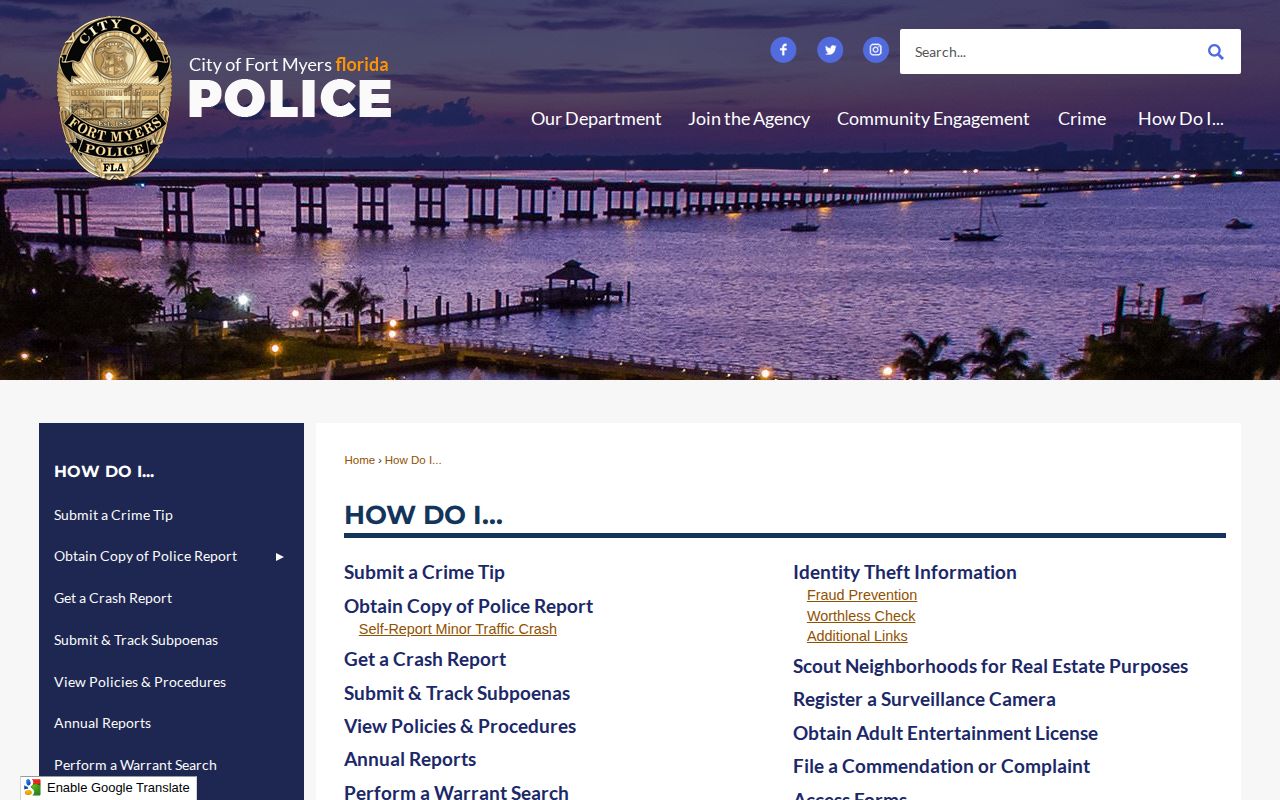
The official handoff is clear. FMPD handles city routes, while LCSO runs the common adult booking search for Fort Myers and the rest of Lee County. The FMPD How Do I page shows exactly how the department routes arrest searches to the sheriff.
Note: App alerts and police posts are selective, so a missing notice cannot establish that no Fort Myers arrest or booking took place.
Fort Myers Booking Custody Stages
Matching the right source to the right stage matters. No single database answers every status question. The city report describes what police say happened. LCSO records county intake and release. The Florida Department of Corrections tracks people sentenced to state prison or placed on qualifying state supervision. Federal locators cover separate systems entirely. Once booking is done, the Lee Clerk docket carries the court path forward.
| Stage | Use this source |
|---|---|
| Incident or FMPD arrest facts | FMPD report and city case number |
| Just booked or in county custody | LCSO Recent Bookings or In Custody search |
| Released from Lee County jail | LCSO Recent Releases, released filter, or date range |
| Sentenced to Florida prison | FDC Offender Information Search |
| Filed charge and final result | Lee Clerk Matrix docket and orders |
A released entry can stay searchable long after the person walks free. The reverse problem exists too. A fresh arrest might not appear right away, because LCSO commits to no fixed posting schedule. One more trap deserves mention. Never search FDC for someone just busted in Fort Myers. That database leaves out county-jail inmates and county probationers, so an empty result there proves nothing. Keep these limits in mind. They stop you from drawing a false conclusion from a blank screen.
Fort Myers Busted News Checks
Local outlets like the News-Press, WINK, NBC2, and FOX 4 cover selected Fort Myers arrests. None runs a complete city booking blotter. A story might draw on an FMPD release, an LCSO photo, a probable-cause affidavit, or a court filing. That context helps you find the right event. It also means omission is routine. News judgment decides what gets printed.
Start with an official identifier from the story. Match it to the sheriff record, then move to Lee Clerk Matrix. The booking charge only shows what the jail received at intake. Prosecutors may file different counts, reduce them, or file none at all. Read the docket entries and the final order instead of trusting an old headline. Even a closed case needs a closer look. Closed alone does not say whether it ended in dismissal, a plea, or a trial judgment.
Third-party county pages belong at the end of your search. Their city labels, photos, alleged charges, and custody hints can lag an official release or a correction. Treat any spelling, booking date, or booking number you find there as a lead only. Never settle identity on facial similarity. When facts clash, compare full legal name, birth date, booking number, case number, arrest date, arresting agency, and the source's own timestamp. For more on how local outlets move from arrest notice to court record, see Lee County Arrest News. The official record still controls every step.