
Lee County Arrest News Sources
Start with the official record. The LCSO Arrest Search gives you a booking number, custody status, alleged charge, arresting agency, and a photograph when one exists. From there, move to agency newsrooms. LCSO social feeds and press releases highlight selected public-safety events, which is helpful background, but a quiet feed does not mean nothing happened.
City coverage varies. Cape Coral Police runs an active newsroom with dated incident and enforcement releases, while Fort Myers Police posts selected items through its Public Information Office. Bonita Springs contracts with LCSO, so sheriff communications serve as the official law-enforcement stream there. No matter which agency made the arrest, every adult booked in Lee County lands at Downtown Jail.
Note: For how a case actually ended, search the Lee Clerk docket rather than relying on a news report or booking entry.
Lee News Outlets and Photos
Outlets here differ in reach and format. FOX 4/WFTX covers all three major Lee cities plus the wider county. Cape Coral Breeze offers the deepest Cape Coral-specific stream. WINK, NBC2, and The News-Press each report selected cases, though none appears to run a complete recurring Lee booking feed.
| Outlet | Coverage | Photos | Where to use it |
|---|---|---|---|
| LCSO Arrest Search | County bookings and releases | When the record returns one | Official booking source |
| CCPD Newsroom | Selected Cape Coral incidents | Sometimes | Official city context |
| FMPD Public Information | Selected Fort Myers cases | Sometimes | Official city context |
| FOX 4/WFTX | Frequent Lee County events | Agency images or operation boards | Regional reporting |
| Cape Coral Breeze | Cape Coral local news | Sometimes | City-specific reporting |
| WINK Crime | Regional event coverage | Varies | Verify live and trace the source |
NBC2 and The News-Press both cover local crime. Neither keeps a stable mugshot or booking section on its site, though. Weigh each report on its own merits. Editorial choice means any outlet can skip routine arrests entirely.
Cape Coral Arrest Release Pattern
Cape Coral stands out. CCPD posts frequent official releases, often several a week, yet publishes no complete daily arrest blotter. A single release might include narrative facts, alleged charges, a name, a date of birth, or a photo. It is a chosen story, not a census of everyone booked.
Cape Coral Breeze tends to build richer stories. It combines CCPD releases with LCSO booking material, probable-cause records, and court documents. Each layer captures a different stage. The police report describes the alleged incident. LCSO records custody. The Clerk shows what prosecutors filed and what the court decided.
How Lee Mugshots Reach News
Florida public-record law opens most nonexempt agency records. Still, exemptions, sealing, expunction, juvenile confidentiality, protected information, and court orders can all block release. An agency may attach an adult booking image to a release it chooses. A reporter may pull one from the roster or file a records request. No outlet is obligated to publish what it obtains.
FMPD policy permits releasing adult arrest information. That can include the incident classification, date, location, identity details, and a booking photograph unless protection rules apply. LCSO shows an image only when its public interface receives one. Absence from a story does not mean absence from agency custody. And absence from the roster does not prove no intake photo was ever taken.
Note: The source of a photograph should be named, because an agency image and an unofficial archive card carry different authority and timing.
From Lee Story to Record
A news story is a doorway, not a destination. It may give you a name spelling, an arresting agency, and an event date. Take those leads into the records and use stronger identifiers. Keep custody separate from outcome along the way.
- Record the full name, event date, arresting agency, and any case or booking number in the story.
- Search LCSO by booking number or by name and date of birth, then compare the agency and date.
- Read custody or release status as a time-bound jail report, not a statement about guilt.
- Open the detail for the alleged booking charge, bond, court, case number, and hearing pointer.
- Search Lee Clerk Matrix by case number and read the docket and orders for filed charges and disposition.
- Use Central Records when an official booking item is blank, old, or needs verification.
For the countywide roster and how the feed works, see the Lee County busted mugshots home page. One caution applies. A story about someone's release never tells you why. Bond, transfer, sentence completion, or another event could all be the cause.
Lee Court Fields Complete Stories
The LCSO record includes court, case, and hearing fields. The sheriff cautions that its data does not show final disposition. The Lee Clerk Matrix picks up where it leaves off. Select Criminal & Traffic and search by case or citation number when the booking supplies one. For a party search, the Clerk documents a last-name wildcard method.
Prosecutors can decline a case or file something different. Courts change bond, dismiss counts, accept pleas, record acquittals, and enter judgments. A label reading "closed" tells you none of that on its own. Read the docket entries and orders. Expect that confidential cases or documents may stay out of public view.
Unofficial Lee Mugshot Archives
Commercial archives sit last in the chain. Official sources come first, then news. Only then do these sites help. Verified Lee County pages exist on Busted Newspaper, RecentlyBooked, Mugshots.com, Arrests.org, Mugshots.zone, and MugshotsLeeCounty.com. They can help you pin down a possible spelling or a date. Permanence is the catch, though. A card can stay online long after the source changes. City tags, charges, custody statements, and photographs may be incomplete or mismatched, so treat any hit here as a lead rather than an answer.
| Archive | Observed coverage | Caution |
|---|---|---|
| RecentlyBooked | Advertises a 30-day Lee view | Unofficial; recheck LCSO and Clerk |
| Busted Newspaper | Large county archive with recent items | Intermittent access and its own disclaimer |
| Mugshots.com | County and individual pages | No reliable county cadence found |
| Arrests.org | Dated daily county-filtered cards | Cloudflare and status lag possible |
| Mugshots.zone | Lee subdomain and monthly archives | Unofficial and may outlive changes |
| MugshotsLeeCounty.com | Locally branded same-day archive | Omits case outcomes and may omit bookings |
The Mugshots.com county landing page appears below as part of the local information landscape. Treat it as one more source, never as an authority.
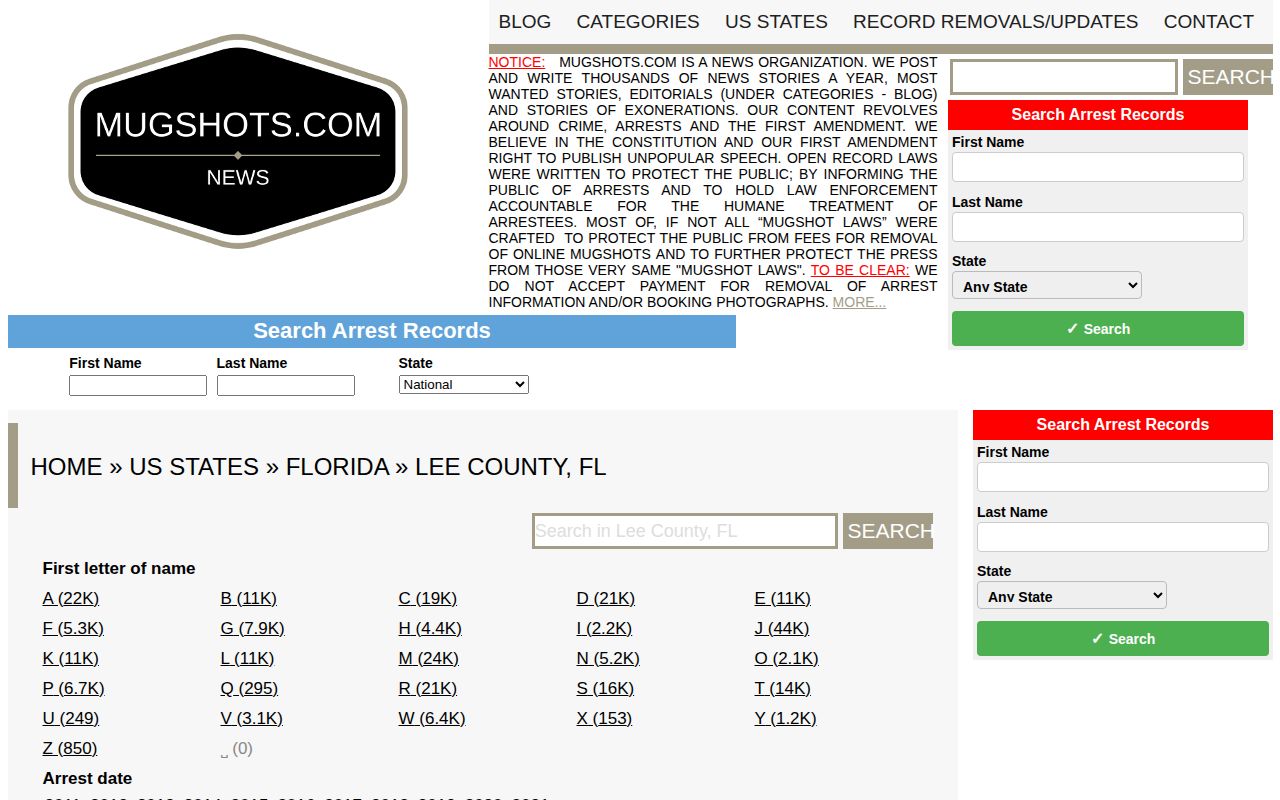
Any possible match from that screen deserves a second look. Rerun the name in LCSO first. Then take it to the Clerk for the case outcome.
Lee Booking Feed Versus News
The official LCSO Arrest Search offers a Recent Bookings query. It covers the current day and the day before. Want a longer window? A custom range can stretch to seven days. The county posts no standalone 72-hour or weekly blotter. The search tool is the reliable path. Newsrooms, by contrast, pick and choose. They cover only the incidents they think deserve ink.
Expect some quirks inside the results. Entries arrive in batches. So a first screen may not fill the whole interval you asked for. Charges appear only after a result is expanded, and photos show up conditionally. LCSO makes no promise about refresh timing or record persistence. That is why an agency release, a roster entry, and a commercial arrest card can surface at different moments while describing the same person, yet not the same point in custody.
Lee City News Is Selective
Lee County's three biggest cities reach the same booking records through different news channels. Cape Coral benefits from an active CCPD newsroom. The Cape Coral Breeze adds coverage there. Fort Myers leans on FMPD releases and regional outlets like WINK, NBC2, The News-Press, and FOX 4. Bonita Springs takes a different route entirely. The city depends on LCSO for law-enforcement communication, since it contracts with the sheriff instead of running its own police force.
None of this changes who holds the record. Every adult taken into Lee County jail custody is booked at Downtown Jail. It makes no difference whether CCPD, FMPD, LCSO, or another agency made the arrest. A city news story can add detail about the incident itself. The county booking record, though, is what documents custody. From there, the Clerk's office tracks prosecution and case outcomes. When no city release exists, check the official roster before concluding an arrest never happened.
Verify Conflicting Lee Arrest Reports
Say two Lee County arrest reports disagree. Start with the hard identifiers: full legal name, birth date, booking number, case number, arrest date, and the agency that made the arrest. Timestamps matter too. A commercial site's card saved yesterday can describe booking, while a sheriff release posted today describes release, so the two can clash without either being wrong.
Keep booking facts and court charges separate. Booking lists what officers logged at intake; the filed charge belongs to the court file. If the booking details still conflict, ask LCSO Central Records for the record itself. If the fight is over a case outcome, that belongs to the Clerk. Never pick the more dramatic story. And a face that looks familiar proves nothing about identity.
Public Record Search
Sponsored Results