
Lee County Busted Mugshot Records
Every booking in Lee County begins at the Downtown Jail. That is the single intake point for the county. Fort Myers Police, Cape Coral Police, the sheriff's office, and state officers all make arrests, yet the sheriff's office writes the booking entry itself. People are later housed at Core or the Community Program Unit. So a result may list a different housing site even though intake happened Downtown.
The mugshot is an ID photo taken at intake. It appears online only when the record includes one. A blank image means little by itself. It could stem from an exemption, a sealed or expunged record, a sync problem, or a photo the courtesy interface simply cannot show.
What Lee Booking Records Show
A Lee booking record is built from distinct fields. Identity, intake, custody, charge, bond, and court pointers each sit in their own place. It reads like a snapshot, not a story. The booking number covers one intake only. The permanent ID can tie multiple sheriff records together. You can also spot which agency opened the case. Housing and release details show how the jail was run at that moment.
| Field | What it shows |
|---|---|
| Name, DOB, permanent ID | Identity details used to distinguish similar names. |
| Booking number and date | The specific Lee County intake event and time. |
| Housing and custody status | Assigned jail component or a reported release time. |
| Booking photograph | An image when the public interface returns one. |
| Charge and agency | The alleged booking charge and arresting authority. |
| Bond, court, case, hearing | Booking-stage bond data and links toward the court matter. |
Expand a record and more appears. Physical descriptors and an address may show up there. Bond amounts can shift over time, and a release entry never explains why someone left custody. Court fields point you toward a case file. They are pointers, not a substitute for the docket. When two people share a name, match the booking number, case number, date of birth, and event date together before trusting a hit.
Request Lee Busted Mugshot Records
The online search is a courtesy tool, nothing more. Need a missing image, an older entry, or a copy with a clear source? Go through the LCSO Public Records Center instead. Central Records sits at 14750 Six Mile Cypress Parkway, Fort Myers, FL 33912, and the records line is 239-477-1350. Hours run Monday through Friday, 7:00 a.m. to 5:00 p.m., with the lobby opening at 8:00 a.m. Expect no fixed turnaround. The agency commits to no set number of days.
- Identify the person by full name and date of birth when known.
- Add the booking number and approximate booking date.
- Ask for the exact booking or arrest record and booking photograph.
- Review the agency estimate, exemptions, medium, and any required deposit.
- Use the Lee Clerk for the disposition rather than asking LCSO to interpret a prosecution.
Fees are set out on the published LCSO fee sheet. A photograph costs $2. Pages run $0.15 single-sided, or $0.20 duplex. Certification adds $1. A CD or other media runs $5. Work past the first 15 minutes may be billed at actual labor or technology rates, and extensive requests can require a 50 percent deposit. The official portal shows where a precise Lee County booking request begins.
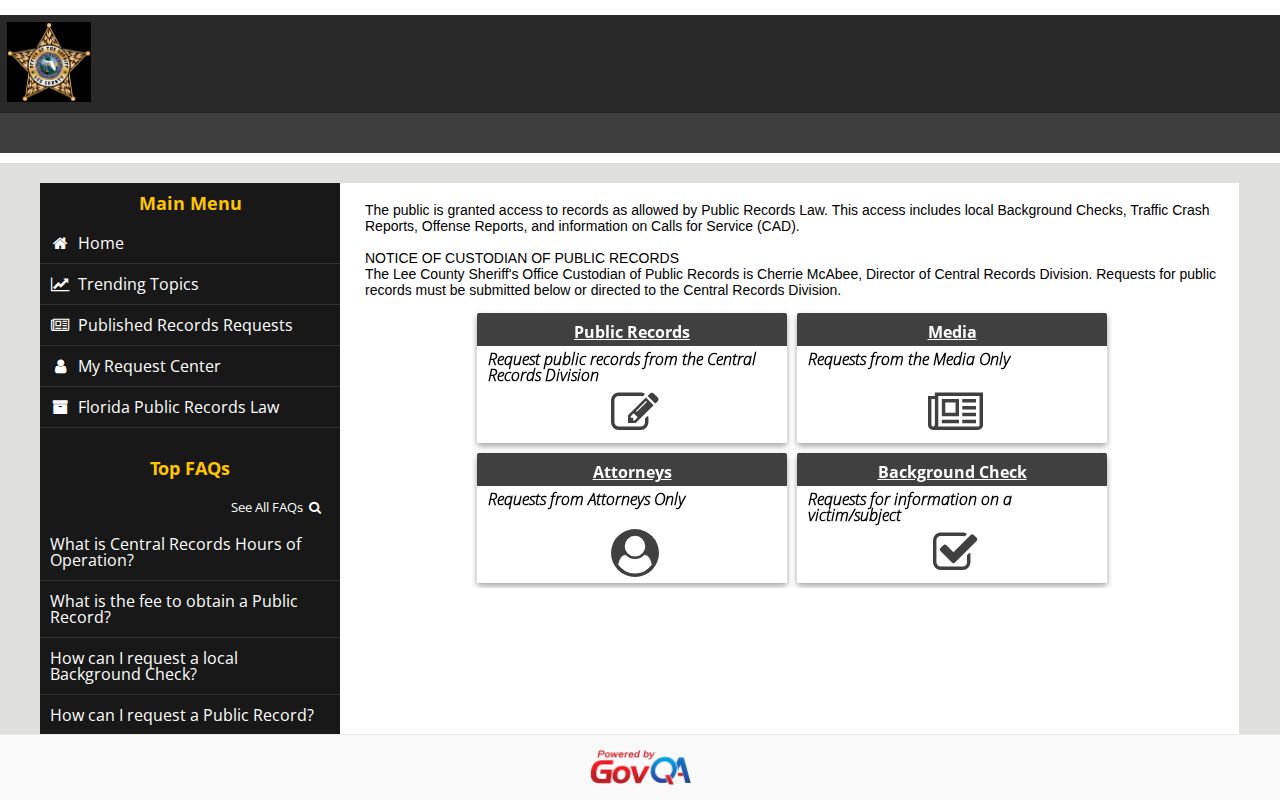
Keep in mind what that screen is. It is a request channel. It is not another roster, and it is not a promise that an exempt photograph will ever be released.
Note: A focused request reduces search time and the risk of receiving a record for a different person with the same name.
Florida Booking Photo Law
Florida keeps its public records wide open. Article I, section 24 of the state constitution and Chapter 119 give you a right to nonexempt records. Some data stays protected under section 119.071 and related laws. Juvenile records are confidential by default under section 985.04, though a few exceptions apply. A custodian can also decline to post a juvenile photo online even when it could be released. No public-records presumption beats a court order, a sealing, an expunction, victim protection, or any other exemption.
Florida Statutes section 901.43 targets commercial publishers whose main business is posting booking photos or charging fees for removal. Once a qualifying written request arrives by registered mail at the registered agent, a covered publisher must run a no-charge removal process. One thing the law does not do: force a sheriff to destroy an agency record just because a private site took down its copy. The Legislature page carries the full text for Lee County readers.
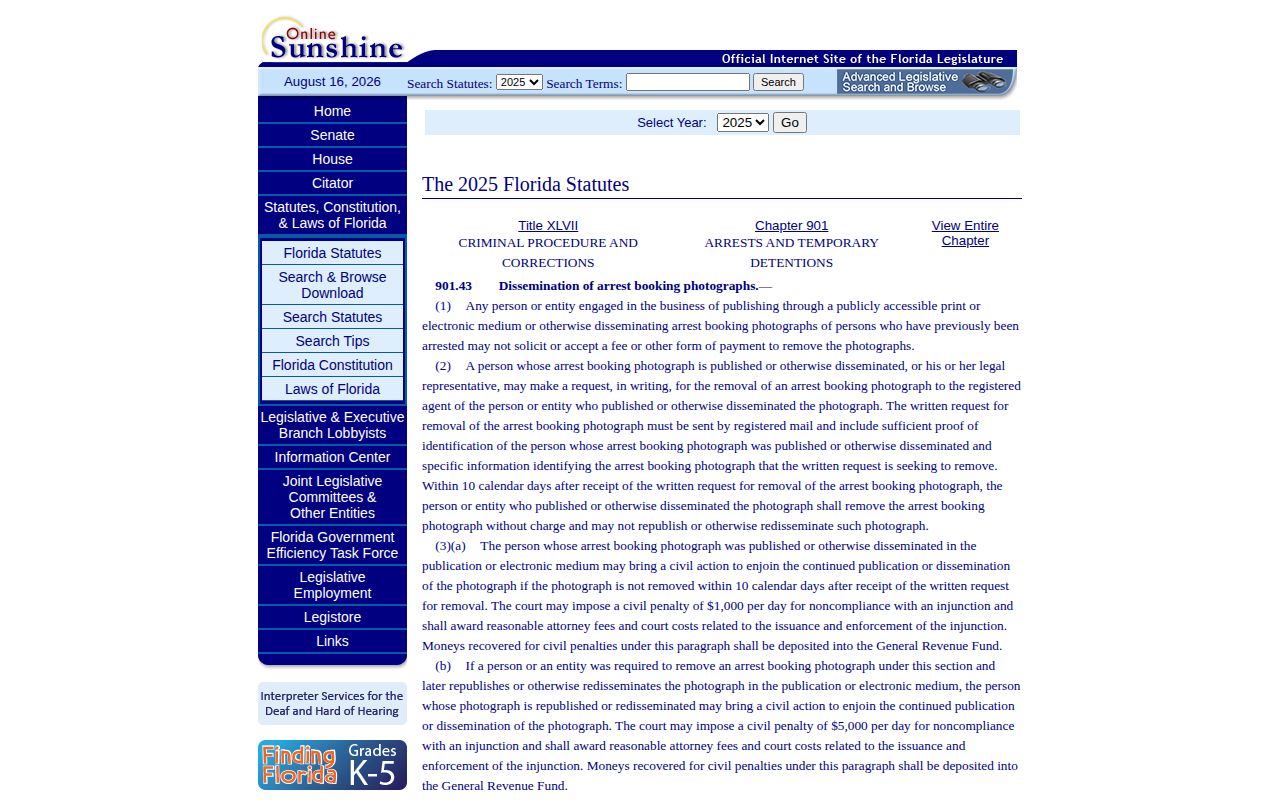
Read the current statute before you send anything. Coverage, proof, delivery, and remedies all hinge on its exact terms.
Removing Lee County Arrest Photos
LCSO's official arrest-photo policy allows removal only when an exemption, court order, sealing, or expunction applies. A dismissal by itself triggers nothing. After a record is sealed or expunged, give the agency two to four weeks for notice and removal. A wrong name or field is a different matter entirely. Corrections go through Central Records, separate from any legal erasure.
Florida relief depends on the route you take. The FDLE seal and expunge process usually starts with a certificate of eligibility, fingerprints, certified dispositions, and a $75 nonrefundable fee. FDLE cites a typical 12-week eligibility review and offers no expediting. Locally, the Lee Clerk wants the certificate, a petition, an affidavit, a published $42 court-record sealing fee, and a hearing. Its Justice Navigator helps with forms but stops short of legal advice.
With unofficial publishers, chase the source record first. Busted Newspaper, RecentlyBooked, Mugshots.com, and Mugshots.zone all publish no-fee correction or removal routes for certain outcomes or errors; Arrests.org posts no stable public policy. Stick to a publisher's free process or the registered-agent route under section 901.43, and never pay a middleman. Once a source URL disappears or changes, Google's Refresh Outdated Content tool can nudge a stale search result. It cannot erase the source.
Older Lee Booking Photo Records
How long does Lee County keep a booking photo? Good question. The sheriff's office publishes no retention period and no fixed display life for these images. That ten-year floor in the date widget is just an interface setting. It says nothing about storage. Central Records can name the applicable Florida General Records Schedule item, confirm whether a photograph remains in custody, and say if its destruction date has passed. Even when a photo disappears, the court file lives on.
For older matters, the Lee Clerk notes that some online records reach back to 1984 or earlier. Pre-2004 or offline files require its Public Records Request System. State prison history is a different trail. The Florida Department of Corrections and its retention schedules come first for an old state prisoner. The Florida State Archives does preserve selected records, though Lee County mugshots do not appear to transfer there routinely.
Find Lee County Busted Mugshots
Start with the LCSO Arrest Search. It serves as both the county roster and the lookup for released bookings, covering anyone processed into county custody. Its reach has limits. A notice to appear with no jail intake, someone held only by the state Department of Corrections, or a person confined in the federal system will not show up. Use the most exact identifier you have.
- Use Recent Bookings for the rolling current and prior-day view, or enter a name and date of birth.
- Set In Custody to yes for people held now; use no or a release range for a past booking.
- Search a known booking or release period in blocks no longer than seven days.
- Open the detail and compare booking number, date, agency, descriptors, and case number.
- Check whether the record actually supplies an image. Never substitute a photo from another source.
- Follow the case to Lee Clerk Matrix for filed charges and disposition.
- Use Central Records when a record or image does not appear or must be verified.
The official interface is shown below through the sheriff's source.
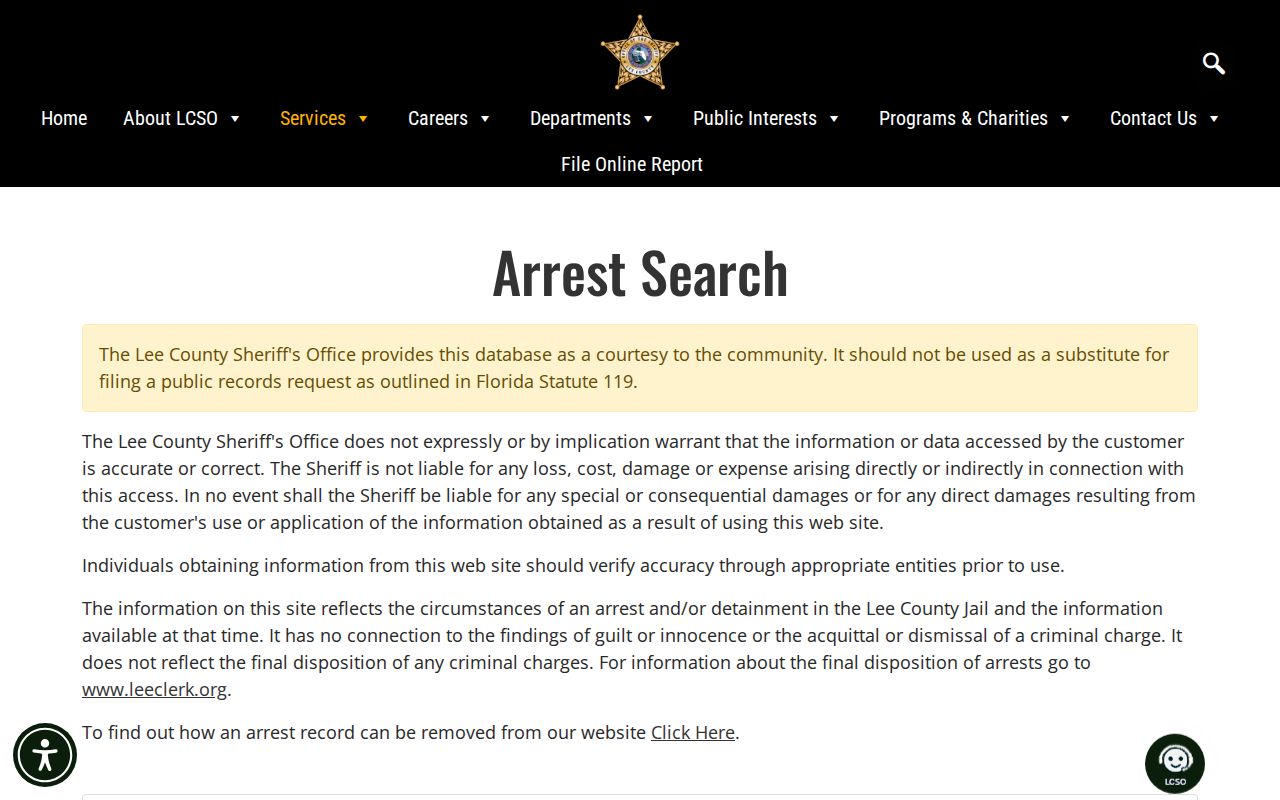
One county system holds all the controls. Current custody, released bookings, date filters, recent bookings, and recent releases sit together in a single interface.
Lee County Busted Roster Search
The search fields cover first, middle, and last name, date of birth, booking number, custody status, and booking or release dates. Booking numbers are your friend. They dodge the common-name collisions that plague a county this size. Date queries cap out at seven days. A blank week tells you nothing about a longer stretch. The current widgets reach back ten years, but nothing promises that range is complete or permanent.
| Search field | Use | Limit or caution |
|---|---|---|
| Name | Broad identity search | Confirm DOB and booking number. |
| Date of birth | Narrows a common name | Use only when reliably known. |
| Booking number | Finds one intake | Different from a city incident number. |
| In Custody | Separates held and released | Status can change after the view loads. |
| Booking dates | Finds intake events | Seven-day maximum range. |
| Release dates | Finds reported releases | Does not state the legal outcome. |
Results arrive in batches, and charges appear only after you expand an entry. A blank photo, an empty charge field, or a first page of hits never proves there is nothing more. LCSO commits to no refresh schedule and no guaranteed persistence online. For urgent custody questions, call the sheriff. The Clerk holds final case results.
Note: Downtown is the intake facility, while Core or CPU may appear as later housing on the same Lee County booking.
Who Got Busted in Lee
Lee County publishes no separate roster, arrest log, or feed product. Recent Bookings and Recent Releases are simply controls inside the main Arrest Search. The recent preset runs a rolling query over the current and prior day. Call it what it is. LCSO documents no exact 24-hour or 48-hour boundary as a service guarantee.
Skip the hunt for an official 72-hour or weekly blotter. There isn't one. The official multi-day substitute is a custom booking-date range, capped at seven days per query. Run consecutive blocks for longer spans and let extra results load. Cape Coral and Fort Myers newsrooms publish selected cases, not a full feed. Bonita Springs has no separate blotter because LCSO polices the city.
Jail scam warning: LCSO reports that scammers track real arrests and then demand gift cards or crypto for a supposed ankle-monitor release. Hang up, verify with the sheriff at 239-477-1000, and never pay the caller.
Where Lee Busted Mugshots Appear
Where a record comes from matters as much as whose name is on it. Official channels come first because they identify the custodian. News archives and commercial sites can hand you a date or a spelling lead, yet their entries go stale, stay incomplete, or miss a correction. And never settle an identity dispute by comparing faces.
| Channel | Custody slice | Photo | Status |
|---|---|---|---|
| LCSO Arrest Search | Booked, held, and released county records | When returned | Official |
| FDC Offender Search | State prison and qualifying supervision | When published | Official |
| Lee Clerk Matrix | Court filing and disposition | Not a mugshot feed | Official |
| City and sheriff newsrooms | Selected incidents | Sometimes | Official but selective |
| RecentlyBooked Lee County | Commercial county archive | Often | Unofficial, verify |
| Busted Newspaper | Commercial county archive | Often | Unofficial, intermittent access |
| Mugshots.com | Commercial county archive | Often | Unofficial, cadence unverified |
| Arrests.org | Commercial daily cards | Often | Unofficial, may be stale |
| Mugshots.zone | Commercial monthly archive | Often | Unofficial, verify |
RecentlyBooked promotes a 30-day Lee County view with multiple daily updates. Those are the site's own claims, not LCSO guarantees. The other verified Lee sections each run on their own cadence and removal policies. Treat any commercial page as a lead, not as proof of present custody or a court outcome.
Lee Arrest Records After Release
Someone just booked can surface in both the recent view and the roster. A person still held should carry an in-custody status, within normal system limits. After release, the booking often stays searchable long after confinement ends. From there the picture splits. A sentence to Florida prison moves the record to FDC, not the county feed. Federal prisoners appear in the BOP locator. Qualifying immigration detention shows up in ICE's locator. Neither of those public tools displays booking photos.
| Status | Best starting point | What it does not prove |
|---|---|---|
| Just booked | LCSO Recent Bookings | Final charge or guilt |
| Held now | LCSO In Custody search | How the case will end |
| Released | LCSO Recent Releases or date range | Dismissal or acquittal |
| State sentenced | FDC Offender Search | A new Lee arrest |
| Federal or ICE custody | BOP or ICE locator | A Lee County mugshot |
Lee Mugshot App Access
The Lee County Sheriff, FL app promotes arrest search, news, advisories, crime mapping, and social links. Don't expect a photo on every entry. The store listing promises no such thing. Treat the app as an official door rather than a separate evidentiary database. Fort Myers Police relies on Atlas One for alerts, nearby incidents, records routing, Arrested Person Search, and Warrant Search. Those linked tools do not add up to a new Fort Myers booking system.
LCSO social accounts and Crime Stoppers posts highlight selected arrests and wanted notices, never a complete roster. FDC victim notifications serve eligible victims or their representatives for certain state-custody events. No Lee-jail-specific VINE enrollment page exists. Don't count on a county notification service.
Check Lee County Arrest Outcomes
A booking is just the first chapter. To see what a case became, open Lee Clerk Matrix and pick Criminal & Traffic. Searching by case or citation number works best. With only a name, the Clerk supports a documented last-name wildcard method for party searches. Expect capped results. Juvenile and other confidential matters stay off limits.
Read the docket and any posted orders. A closed file does not reveal the ending. Dismissal, plea, diversion, trial judgment, or something else all hide behind that word. Prosecutors sometimes file charges unlike what booking showed. Judges can change bond too. So a Lee County busted mugshot never tells the whole legal story.
Why Lee Busted Mugshots Go Missing
An empty online result has several possible causes, and none should be treated as proof by itself. The date window may be wrong, a name may be misspelled, intake processing may still be underway, or the person may have received a notice to appear without entering county jail. A person held only in state, federal, or immigration custody belongs in another locator. The public interface can also omit an image because the API returned no image, a legal restriction applies, or the record was sealed or expunged.
Start by clearing filters and using the exact booking number. If that is unavailable, combine surname, date of birth, and a narrow booking-date range. Search no more than seven days at once, and repeat for the next block. Compare the arresting agency with the agency named in any police report. A Cape Coral or Fort Myers incident number is not the same as the LCSO booking number, so searching one in the other system can create a false “no record” result.
If a known Lee County booking appears without a photograph, preserve the booking number and ask Central Records for the booking record and attached booking photograph. The custodian will decide whether the item exists, remains in agency custody, and is subject to an exemption. Do not fill the gap with a social-media portrait, an old news image, or a commercial site's photo. That can connect the wrong image to the wrong person.
When two records disagree, compare their timestamps and the stage they describe. A police release can report an arrest before the jail entry is complete. A roster can show release after a commercial card was copied. A Clerk docket can show a later filed charge that differs from the booking allegation. Each source can be accurate about its own moment while still appearing inconsistent. Identity and outcome should be resolved through record numbers and the responsible office, never by choosing the most severe version.
Busted Mugshots Across Lee Cities
The city where an arrest starts decides which police department holds the report. LCSO stays the shared booking source for adults accepted into county jail custody.
- Cape Coral Busted Mugshots: CCPD creates city reports, and LCSO creates the booking entry.
- Fort Myers Busted Mugshots: FMPD explicitly routes arrest searches to LCSO.
- Bonita Springs Busted Mugshots: LCSO provides both contract policing and county booking.
Each city's news coverage picks and chooses. The county roster carries the shared intake record, and Lee Clerk holds the final result.
Public Record Search
Sponsored Results